When a Saratoga County lot looks large enough for a house, garage and driveway, it is tempting to start with a sketch and a construction estimate. First establish how much of the parcel can support the intended project. Wetlands and regulated adjacent areas can affect the layout even when the wet ground is well away from the spot where you hope to build.
That review needs current information. New York’s freshwater-wetlands program changed in 2025, and a 2026 court decision has affected how DEC is administering parts of it. An old map printout or a summary written when the rules first changed may give an incomplete picture.
Use DEC’s current process
DEC’s current program page addresses the April 8, 2026 Albany County Supreme Court decision. The agency says it continues protecting wetlands that remain jurisdictional and lists wetlands of at least 12.4 acres and previously mapped wetlands among the protected categories. It also identifies a protected adjacent area. This is DEC’s published program guidance, not a parcel-specific legal opinion.
For a property outside the Adirondack Park, use the agency’s jurisdictional-determination process. A parcel determination identifies whether regulated wetlands or adjacent areas are present in the area reviewed. DEC explains that it does not establish their exact extent; delineation is needed to confirm boundaries, and a project determination addresses whether the proposed work may need a wetland permit.
There is also a reassessment route for determinations issued between January 1, 2025 and April 8, 2026. If a seller supplies a determination from that period, discuss it with DEC and your project professionals. Do not assume that the court decision either eliminates the restriction or leaves every earlier conclusion unchanged.
Map the project, not just the house
Show the consultant the entire intended use: driveway, utilities, septic area, grading, drainage work and any future outbuilding you consider essential. A house footprint that appears workable can still leave an unresolved connection between the building and the road. Ask which conclusions are established, which rely on preliminary mapping, and which require fieldwork or agency review.
DEC’s informational mapping description cautions that mapping is not the definitive way to determine regulated wetlands on a particular property. Use mapping to organize the inquiry. Have the final project decisions rest on the appropriate determination and site information.
For land inside the Adirondack Park, the state wetlands contact is the Adirondack Park Agency. DEC also directs owners to consider federal requirements separately. Keep the correct agencies involved; a favorable answer from one does not answer every approval question.
Put the uncertainty into the offer
For a buyer, the practical issue is the cost and time needed to establish a usable plan. Ask your attorney to structure the investigation period around the work actually required. Do not value uncertain acreage as if every square foot were available for construction.
For a seller, a clearly labeled file containing current determinations, surveys and project limits can explain the property more credibly than an unqualified “buildable lot” description. Our Saratoga County property-research guide covers the broader records search. The wetland question should be resolved far enough to support the specific use behind the asking price or offer.
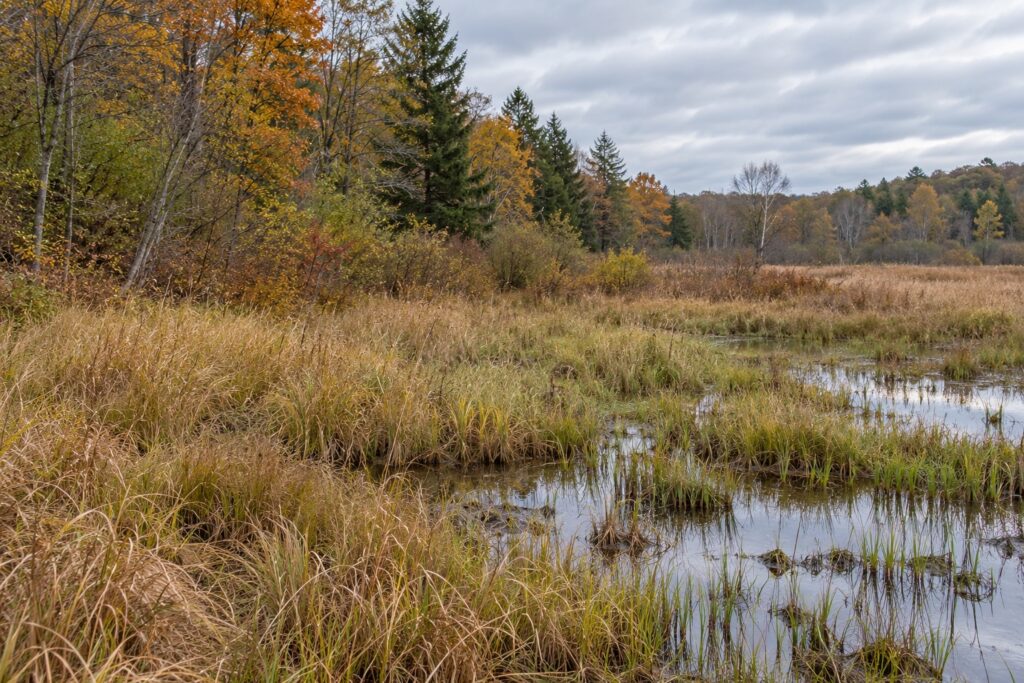
AI-generated editorial illustration of a wet meadow; it does not depict a mapped site or establish wetland jurisdiction.
Sources checked October 20, 2026.