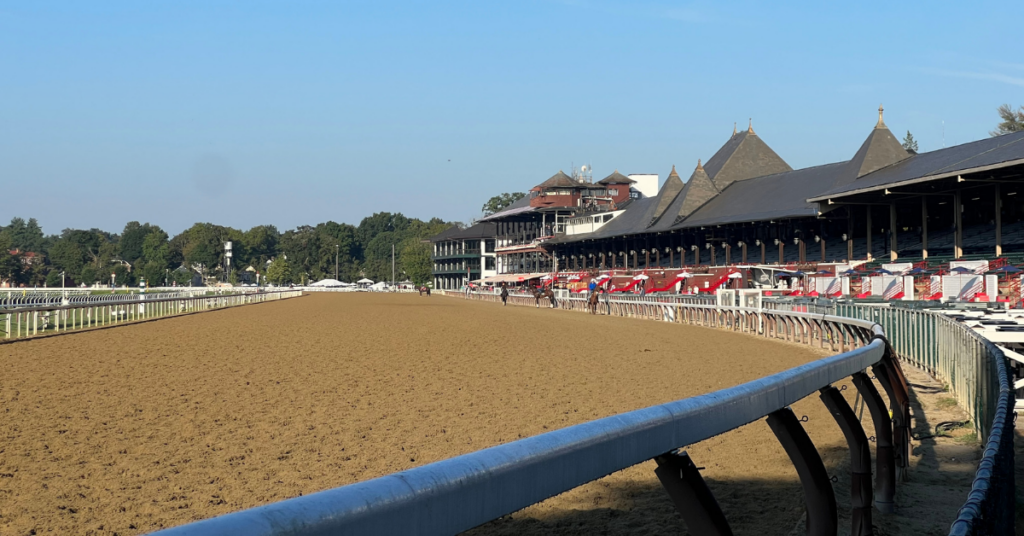
Travers Day is one of Saratoga Springs’ biggest visitor days, concentrating hotel stays, restaurant traffic, retail purchases, transportation, race-course operations, and national attention into a single Saturday. The best public economic study, however, measures Saratoga Race Course across a full season and the wider nine-county Capital Region. It does not measure the Travers alone. This race-day guide separates that annual benchmark from what can be said about today, then lists the ten horses and their current owner, trainer, and jockey connections.
Race-day snapshot: The field and connections below were checked against the NYRA and Equibase cards and NYRA’s 1:30 p.m. Eastern changes report on August 29, 2026. Late changes and live odds remain possible. This is not a betting guide.
The short version
- The latest independent study estimated $371.1 million in annual regional economic output associated with Saratoga Race Course, based on 2021 activity. That is not a Travers-only figure.
- Travers is a peak-demand day: the 2025 crowd of 48,255 was about 1.8 times the meet’s average daily attendance, but wagering handle is not the same as money spent in Saratoga.
- Today’s Grade 1, $1.25 million Travers is Race 13 at 6:35 p.m. Eastern and has ten scheduled starters as of the source check.
What Travers Day changes in Saratoga Springs
Travers Day compresses a large share of the summer meet’s visitor activity into one weekend. Guests arrive before race day, fill rooms across Saratoga Springs and surrounding communities, eat and shop downtown, use local transportation, and support work both at the Race Course and throughout the racing supply chain.
The most direct local effects appear in several places:
- Lodging: Hotels, inns, short-term accommodations, and overnight stays in nearby communities.
- Food and hospitality: Restaurants, bars, caterers, groceries, concessions, and event staffing.
- Retail and transportation: Downtown shops, parking, taxis and rides, fuel, deliveries, and other visitor purchases.
- Racing operations: Track employees, security, concessions, trainers, grooms, exercise riders, veterinarians, farriers, jockeys, and suppliers.
What the $371 million figure actually measures
A Camoin Associates study commissioned by the Saratoga County Industrial Development Agency used 2021 data to estimate the Race Course’s impact across Albany, Columbia, Greene, Montgomery, Rensselaer, Saratoga, Schenectady, Warren, and Washington counties. It reported $371.1 million in annual economic output, $157.9 million in employee earnings, and 2,937 jobs. It also estimated annual tax revenue of about $2.1 million for Saratoga Springs, $2.4 million for Saratoga County, and $7.3 million for New York State.
The study identified nearly $158.7 million in direct, net-new off-track visitor spending over the full season: $83.6 million for lodging, $33.3 million for retail, $17.7 million for meals, and about $12.0 million each for entertainment and transportation. After supplier and employee-spending effects, the modeled off-track visitor impact reached $244.3 million.
Those numbers are useful context, but they are not a Travers Day price tag, local profit, or a measure of benefits after public-service and congestion costs. The study combines track operations, race-participant activity, visitor spending, and indirect and induced effects; some participant activity runs from April through November. There is no authoritative public Travers-only impact study, so dividing $371.1 million by the number of race days would create a number the research did not establish.
Why Travers is still a peak economic day
NYRA reported 48,255 paid attendees on 2025 Travers Day, compared with average daily attendance of 26,544 across the 40-day summer meet. All-sources wagering handle was $54.3 million on Travers Day versus a $19.8 million daily meet average. That scale helps explain why the weekend matters to lodging, dining, retail, and staffing.
The distinction between handle and local spending matters. All-sources handle includes wagers placed away from Saratoga, and the amount bet is not revenue retained by local businesses. Attendance also does not show where every visitor stayed, what each person spent, or how much spending was new to the region. Final 2026 attendance and economic results were not available before today’s Travers post time.
How to watch the 2026 Travers
The Travers itself is scheduled live on the FOX broadcast network during FOX Saratoga Saturday from 5:00 to 7:00 p.m. Eastern, with Race 13 post time at approximately 6:35 p.m. Earlier coverage is scheduled for FS2 from 11:00 a.m. to 1:30 p.m., FS1 from 1:30 to 3:00 p.m., and FS2 from 3:00 to 5:00 p.m.; coverage is scheduled to continue on FS1 from 7:00 to 7:30 p.m.
NYRA also lists free streaming on YouTube and a stream on NYRA.com that requires a NYRA Bets login. Broadcast schedules can change, so confirm local listings and NYRA’s current TV schedule.
The 2026 Travers field and connections
The official morning line is shown for identification, not as a live price. NYRA’s changes report listed no Race 13 scratches or jockey changes as of 1:30 p.m. Eastern.
| Post | Horse | Owner | Trainer | Jockey | M/L |
|---|---|---|---|---|---|
| 1 | Emerging Market | Klaravich Stables, Inc. | Chad C. Brown | Ricardo Santana Jr. | 15-1 |
| 2 | Leading Change | Wathnan Racing | Brad H. Cox | Manuel Franco | 12-1 |
| 3 | Napoleon Solo | Espoir USA, Inc. | Chad Summers | John R. Velazquez | 8-1 |
| 4 | The Puma | OGMA Investments LLC; High Step Racing; TCC Stables LLC; YNG Stables LLC; JR Ranch | Gustavo Delgado | Javier Castellano | 8-1 |
| 5 | Renegade | Robert Low; Lawana L. Low; Repole Stable | Todd A. Pletcher | Tyler Gaffalione | 3-1 |
| 6 | Ocelli | Ashley Durr; Anthony Tate; Ribble Farms; Hoolie Racing Stable LLC; Kamp Racing Stables | D. Whitworth Beckman | Edgard J. Zayas | 20-1 |
| 7 | Sea Strike | Flanagan Racing | Chad C. Brown | Flavien Prat | 5-1 |
| 8 | Baby Vino | Delta Squad Racing LLC; HRH Prince Faisal bin Khaled bin Abdulaziz Al-Saud; Cosmo Stables | Lindsay Schultz | Paco Lopez | 10-1 |
| 9 | Golden Tempo | Phipps Stable; St. Elias Stable | Cherie DeVaux | Jose L. Ortiz | 5-2 |
| 10 | Silent Tactic | John C. Oxley; Victoriam Farm | Mark E. Casse | Luis Saez | 10-1 |
Why the Travers is called the Mid-Summer Derby
First run in 1864, the Travers is one of the oldest major stakes races for three-year-olds in the United States and the centerpiece of the Saratoga meet. Its “Mid-Summer Derby” nickname reflects its place on the calendar: by late August, stars from the spring Triple Crown races meet later-developing three-year-olds over 1¼ miles, creating a second season-defining test for the division.
The race’s history is part of its weight. Jim Dandy’s 100-1 upset of Triple Crown winner Gallant Fox in 1930 remains one of the sport’s defining shocks; Whirlaway became the only Triple Crown winner to take the Travers in 1941; and the winner’s colors have been painted on the infield canoe since 1961. Those traditions make Travers Day more than Saratoga’s signature race: it is an annual meeting point between the sport’s history and its current generation of leading three-year-olds.
Sources
Sources checked August 29, 2026. Agency pages, statutes, forms, and requirements can change; confirm the current version before relying on them.
- Saratoga County IDA economic-impact study 2021-based annual economic output, jobs, earnings, visitor-spending, and tax estimates for the nine-county Capital Region.
- NYRA summary of the economic-impact study Summary of the study’s annual Race Course findings and geographic scope.
- NYRA 2025 summer meet results Official Travers Day and full-meet attendance and handle comparisons.
- NYRA 2026 Travers guide Official 2026 race schedule, purse, field overview, connections, and historical context.
- NYRA 2026 Saratoga television schedule Official FOX, FS1, FS2, YouTube, and NYRA.com coverage schedule for Travers Day.
- NYRA Travers milestones Official history of the first running, Mid-Summer Derby milestones, major upsets, Triple Crown winners, and the infield canoe tradition.
- NYRA live Saratoga Race 13 card Current field, post positions, owners, trainers, jockeys, and odds.
- Equibase official Race 13 entries Current entry record used to reconcile complete ownership groups.
- NYRA scratches and program changes Race-day scratches, jockey changes, track condition, and update time.
Thinking about a Saratoga Springs property?
Send the address, intended use, timing, and the decision you are working through. We’ll help separate property-specific facts from the broader Saratoga market context.
This article provides general real estate information, not legal, tax, lending, environmental, engineering, inspection, accessibility, or investment advice. Requirements and property conditions vary. Confirm current information through the applicable public agency, transaction documents, and appropriately qualified professionals. Browsing, reading, or submitting an inquiry does not by itself create a brokerage, agency, fiduciary, or client relationship.