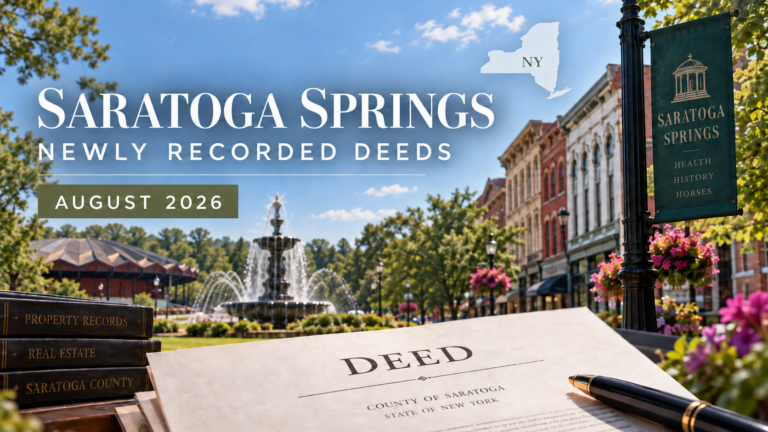
A deed recording adds a dated entry to a property’s public record. For anyone following Saratoga Springs real estate, it can be a useful place to start: which property is involved, what kind of document was filed, and where to look next. TopNetRealty’s new Newly Recorded Deeds series brings those entries into one readable monthly report.
Coverage is limited to the City of Saratoga Springs, New York, including its inside and outside tax districts. The first installment covers August 2026 recordings.
The short version
- The series follows the month a deed was recorded by the Saratoga County Clerk.
- Each installment identifies its source coverage and separates document counts from sales or property counts.
- Our planned publication day is the second Monday of each month, covering the prior calendar month.
A monthly view of the public record
The focus is the City of Saratoga Springs. A Saratoga Springs mailing address alone does not establish that a property is inside the city, and the Town of Saratoga is a separate municipality. We use the recording information and parcel records to keep that boundary clear.
We begin with August 2026. That first installment reviews a supplied packet of 67 recorded instruments and explains its coverage limits. Future reports are planned for the second Monday of the following month. The August report launches on September 17; it is not backdated to the regular publication day.
Why we call it “newly recorded deeds”
The recording date is the date attached to the County Clerk’s filing. The deed may have been signed earlier, and the recording date does not establish when a closing took place. Our monthly grouping uses the recording date.
A deed can also reflect a transfer involving a trust, an estate, a family member, or a partial interest. Those circumstances need to be understood before treating a filing as a comparable sale. A document bearing a small stated consideration, such as $1 or $10, does not by itself establish a property’s market price.
Transfer-on-death deeds receive their own label in the reports. Under New York Real Property Law § 424, the contemplated transfer is effective at the transferor’s death. Recording that document is not evidence of a completed sale.
How to read each monthly ledger
Every entry carries an instrument number so you can locate the underlying record. The ledger also identifies the recording date, document type, and property location or legal-description reference. Parcel numbers provide another way to distinguish properties with similar addresses.
We count each unique instrument once. Two deeds involving the same parcel remain two documents, while a deed covering several parcels remains one document. Neither count should be described as the number of homes sold.
Property locations may be matched to official assessment records. A party’s mailing address is not used as a substitute for the property address. When a number or unit cannot be established, we retain the available description and make that limit visible.
Use the report to ask better property questions
A recording can point you toward a property worth researching, but it does not answer every question about that property. Buyers can use the instrument number to begin reviewing the recorded history. Owners can follow nearby activity and ask whether a particular transfer is relevant to their own property.
Before using an entry to discuss value, confirm the interest conveyed, the property’s characteristics and condition, the transaction terms, and whether the parties and circumstances support a meaningful comparison. A deed alone also does not establish development approval, current zoning compliance, or a plan to sell or redevelop.
When the reviewed documents explicitly state a substantial consideration amount, we may report it with its source. We will not turn nominal amounts, recording fees, or transfer taxes into an assumed sale price. A monthly median or total sales volume requires a separately validated sales dataset.
Coverage and corrections
Each installment states the recording period and the records reviewed. If we cannot reconcile a packet to a complete official search result, we describe it as the reviewed packet rather than a certified total of all city recordings. Later filings, corrections, or indexing changes may require an update.
See an entry that needs a second look? Send TopNetRealty the instrument number and the detail in question. We can revisit the source and note a material correction in the article.
Sources
Sources checked September 17, 2026. The County Clerk provides the underlying land records; the state statute explains transfer-on-death deeds.
- Saratoga County Clerk: records and land-record access Official starting point for locating recorded instruments. Search by the instrument number shown in the ledger.
- New York Real Property Law § 424 Transfer-on-death deeds and the distinction between recording and a transfer effective at death.
Put a property record in context
Following a particular Saratoga Springs property or preparing to buy or sell? Share the property address and instrument number with TopNetRealty. We can help organize the real estate questions and identify which records deserve a closer look.
This article provides general real estate information, not legal, tax, lending, environmental, engineering, inspection, accessibility, or investment advice. Requirements and property conditions vary. Confirm current information through the applicable public agency, transaction documents, and appropriately qualified professionals. Browsing, reading, or submitting an inquiry does not by itself create a brokerage, agency, fiduciary, or client relationship.